Why you'll never see salmon at a traditional sushi counter
Sit at a serious sushi counter in Tokyo and you can order tuna in three grades, gizzard shad, sea eel, sea urchin, a dozen things you’ve never heard of — but not salmon. It simply isn’t there. Which is strange, because salmon is the single most popular sushi topping on earth, and it’s everywhere in Japan’s conveyor-belt shops. The reason it’s missing from the good counters is one of the better stories in sushi: a tale of parasites, a Norwegian sales pitch, and what a traditional chef is willing to call his own.
Salmon was never sushi
For most of Japanese history, salmon was a cooked fish. The wild Pacific salmon Japan knew — 鮭, sake (often said shake) — turned up grilled for breakfast, salted, or flaked into rice balls. What it never was, was raw. Two reasons. First, parasites: wild Pacific salmon commonly carries anisakis, a nematode that makes eating it raw a genuinely bad idea. Second, it’s relatively lean — short on the fat that makes a fish luscious as sashimi. So for centuries, salmon was a humble, cooked staple, nowhere near the sushi counter.
Then Norway sold it to Japan
The salmon-on-rice you know is barely forty years old, and it isn’t Japanese — it’s Norwegian. In 1986 the Norwegian government launched Project Japan, a campaign to find a buyer for the country’s booming farmed-salmon surplus. Its point man, Bjørn Eirik Olsen, has since been called “the inventor of salmon sushi.”
His pitch had one enormous advantage over the old fear: farmed Atlantic salmon is not wild Pacific salmon. Raised in pens on controlled feed, it carries no anisakis — and it’s far fatter and richer, ideal raw. The problem was that Japanese buyers “knew” salmon couldn’t be eaten raw, full stop. So Olsen rebranded it: he sold the new fish not as 鮭 (sake) but as サーモン (sāmon) — the English word, in katakana — to sever it in people’s minds from the cooked fish they grew up with.
It took years. The breakthrough came in the early 1990s, when Olsen persuaded the Japanese frozen-foods giant Nichirei to take five thousand tonnes — on the condition that it be sold only for eating raw. Then the timing turned golden: the bubble economy collapsed in 1991, cheap conveyor-belt sushi boomed, and salmon — fatty, mild, inexpensive, kid-friendly — was the perfect kaiten fish. By 1995 it was everywhere.
サーモン and 鮭
That split still lives in the language. 鮭 (sake) is the old wild Pacific salmon — cooked, salted, breakfast. サーモン (sāmon) is the newcomer — farmed, fatty, served raw, whether from Norway, Chile, Tasmania, or a Japanese pen. When a menu says sāmon, it’s telling you, in a single word, that this is the imported raw fish, not the traditional one.
So why still not at the good counters?
Because none of it is Edomae. Tokyo’s sushi tradition was built over a century around the fish of its own bay and the Japanese coast — wild, seasonal, each with a peak (shun) and a prized origin (meisanchi), much of it cured or aged by hand. Farmed salmon has none of that: no season, no storied bay, no aging craft, and an unbreakable association with cheap conveyor sushi. To a traditional chef it isn’t a bad fish so much as not his fish — a foreign newcomer with no place in the canon he’s spent a life mastering.
The spring exception: sakura-masu
There is one salmon-coloured fish you will meet at a good counter, and it proves the rule. Sakura-masu (桜鱒, “cherry salmon”) — the sea-run form of the native yamame trout — surfaces for only a few weeks each spring, named for the blossom season it arrives with. It is everything farmed sāmon isn’t: wild, Japanese, and fiercely seasonal, a true shun fish, prized around Toyama and the northern coasts. Chefs treasure it, usually serving it lightly cured or as zuke, its flesh a paler, more delicate orange than supermarket salmon. The point is that the counter never objected to the colour — it objected to the farmed, imported, year-round fish. Give it a wild salmonid with a season and a story, and the door opens.
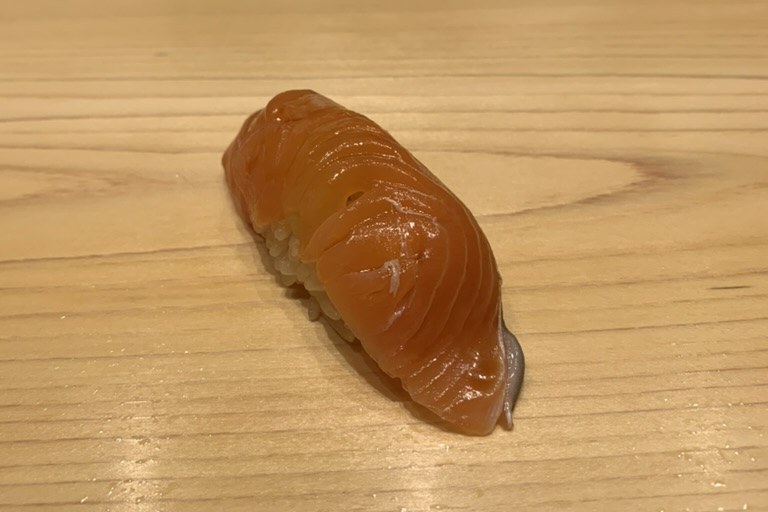
None of this is pure snobbery, either. Salmon is genuinely loved in Japan — often the single best-selling neta at kaiten shops. But at the serious Edomae counter, the everyday sāmon stays off the menu by choice.
So the next time an omakase comes and goes without a single piece of salmon, that’s not an oversight. It’s the counter quietly telling you what it considers its own.