Sushi Yasu: a self-taught counter in Saitama that shops to your order
Let’s be honest about the first problem with Sushi Yasu (鮨やす): it is a long way out. Okegawa is well up the Takasaki line into Saitama, forty minutes north of Ueno before you even start the ten-minute walk from the station, and when you arrive there is no sign on the building. Five or six seats, one group at lunch and one at dinner, and a headline omakase of ¥33,000 including tax — central-Tokyo money, a long way from central Tokyo.
So the only question that matters is what the trip buys you. The answer is a counter that will cook to your order — and a chef who has built the entire shop around being able to.
The drive
Every morning, the chef gets in a car and drives to Toyosu.
That is not a small commitment from Okegawa. It’s about 45 km in a straight line and closer to 60 by road, each way — a round trip of roughly 120 km, before service, every day the shop opens. Most counters this far from the city buy through a local wholesaler or take a delivery, and there’s no shame in it; it’s how the overwhelming majority of good suburban sushi works.
He doesn’t. He goes to the market himself and picks the fish with his own hands, from the same floor the Ginza counters buy on. That single decision is what makes the price legible. You aren’t paying Tokyo prices for Saitama fish — you’re paying for the same fish, carried north by the man who chose it.
Nobody taught him
Here is the part that genuinely sets the shop apart, and it runs against almost everything Japanese sushi believes about itself.
Sushi in Japan is a lineage craft. The standard path is a decade or more under a master before you touch a customer’s rice, and the great houses are family trees you can draw — the Kanesaka–Saito school, the Jiro line, the Miyakozushi chefs who produced Sugita. Ask a chef where they trained and the name of the house is half the answer.
The chef at Sushi Yasu doesn’t have one. He is entirely self-taught — and he doesn’t eat at other sushi restaurants to study them either. No pilgrimage to the famous counters, no borrowing of another chef’s grammar. What’s on the plate is what he worked out himself.
That’s an unusual thing to admit in this industry, and it explains a lot downstream. It explains why the shop has no house name to trade on, and it goes some way to explaining the Tabelog score of 3.07 across just 15 reviews — a number that says nothing about the food. Neither Michelin nor Tabelog is a bible, and Tabelog’s algorithm holds low-volume shops near 3.0 by design: a counter serving two groups a day will never accumulate reviews like a room turning forty covers a night. A shop with no lineage, no sign, no phone and six seats is close to invisible to the machinery people use to find restaurants. That invisibility is not a verdict.
You can tell him what you want to eat
Omakase (お任せ) means “I leave it to you.” At most counters that’s the deal in both directions — the chef decides, you eat what arrives, and asking for something specific is at best gauche.
Sushi Yasu inverts it. Tell the chef in advance what you want to eat, and he will buy it for you.
Once you see how the shop is built, the mechanism is obvious — and it’s why this isn’t a gimmick:
- He takes one group per service, so on any given day he knows exactly who is coming and what they asked for.
- He goes to Toyosu himself that morning, so he can act on it.
- Bookings close two days ahead, which is the lead time he needs to carry the request to the market.
Those three rules aren’t three quirks. They’re one system. The distance, the tiny capacity and the advance-booking rule are the price of a counter that shops for you specifically — none of it works if he’s running four sittings and buying on a standing order.
It also quietly resolves the thing that makes high-end sushi stressful for a lot of people: the fear of the piece you don’t want. If you can’t do uni, or you came for maguro and little else, that’s a conversation before the booking rather than an awkward moment at the counter. It’s close to the opposite of the theatre-style counter, where the sequence is the show and you are the audience.
The door
The access terms follow from all of the above, and they read like a deliberate filter:
- There is no phone number. The official site lists the telephone field as
--. Booking is by LINE or Instagram DM, and nothing else. - One group at lunch, one at dinner. Not one seating — one group. You won’t share the counter with strangers.
- Book at least two days ahead. Sometimes a day’s notice if you ask; never “now.”
- Minimum two guests. Solo diners aren’t accommodated.
- The whole party eats the same course.
- Booking out all six seats is by consultation, and not offered to first-time visitors — a soft, local cousin of ichigensan okotowari (一見さんお断り). Anyone can book a seat; the room is something you earn.
Weekday service is evenings only. Wednesdays, weekends and holidays open from 11:30, and lunch is the softer target as it is nearly everywhere — the general principle in how to get a reservation in Japan.
The meal
The course opens with a run of tsumami before any nigiri appears, each dish on its own piece of ceramic rather than a house plate — a brushed grey bowl, a deep green glaze, a celadon round.
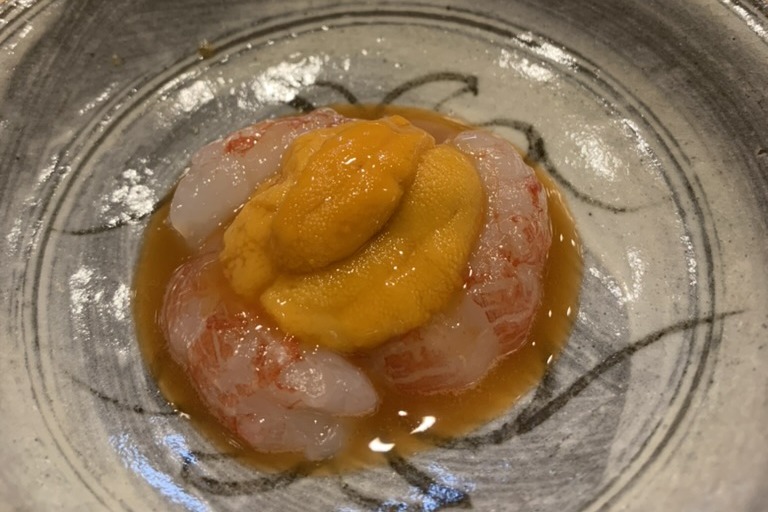
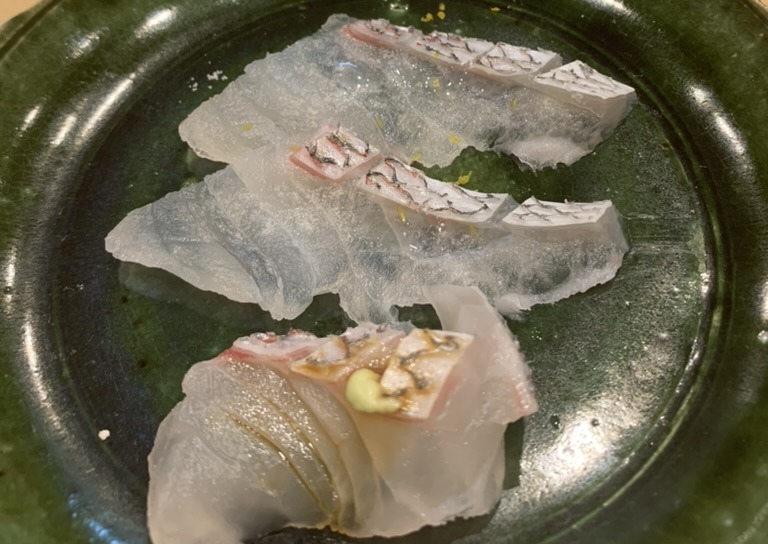
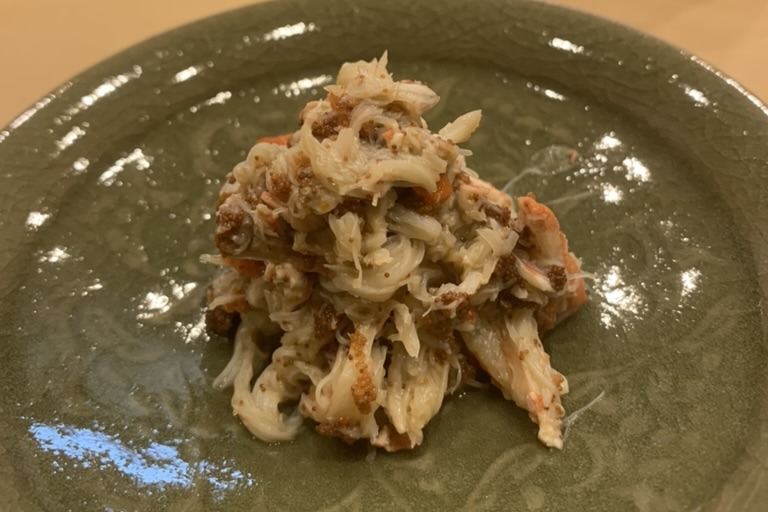
Then the nigiri, which arrive one at a time on a rough stone slab set down on the counter — not a plate, not the bare wood.
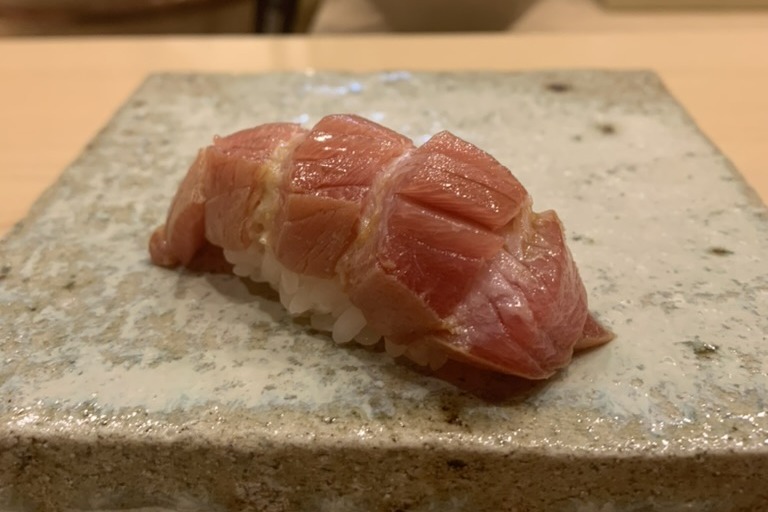
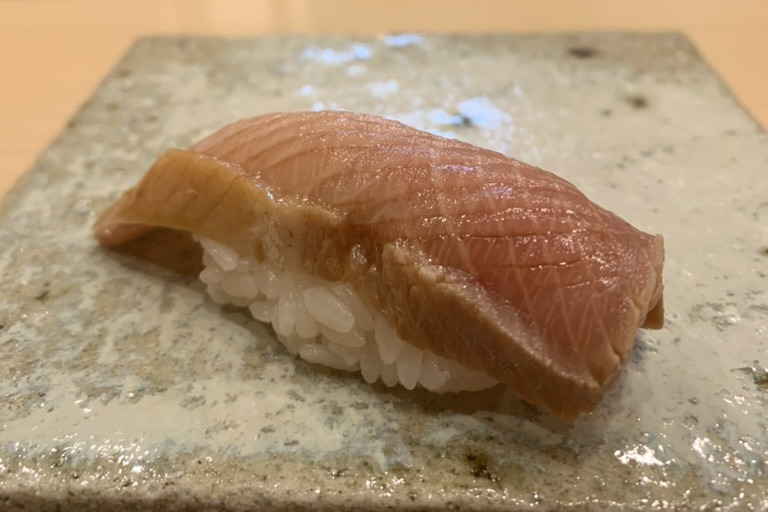
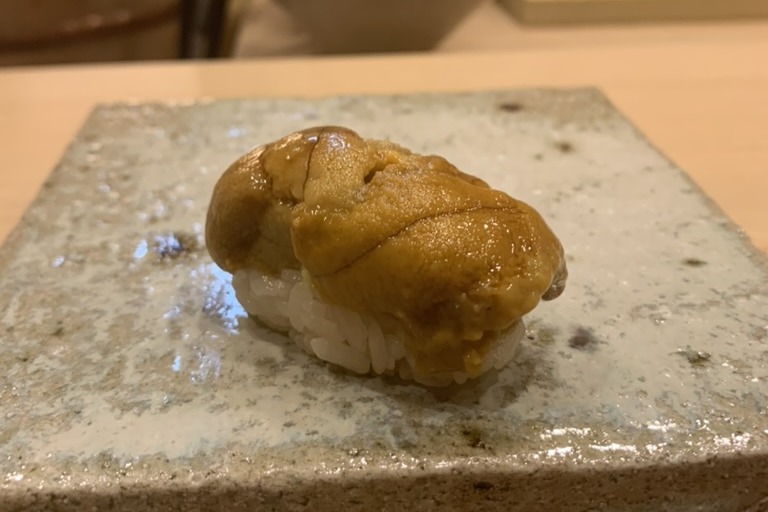
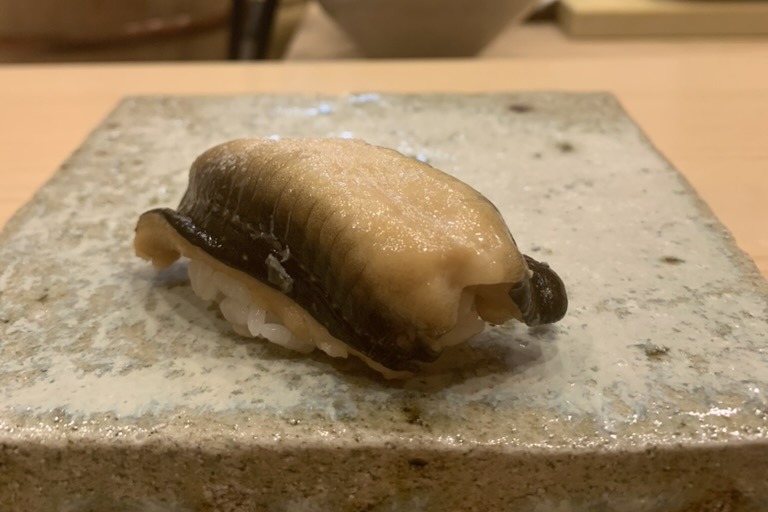
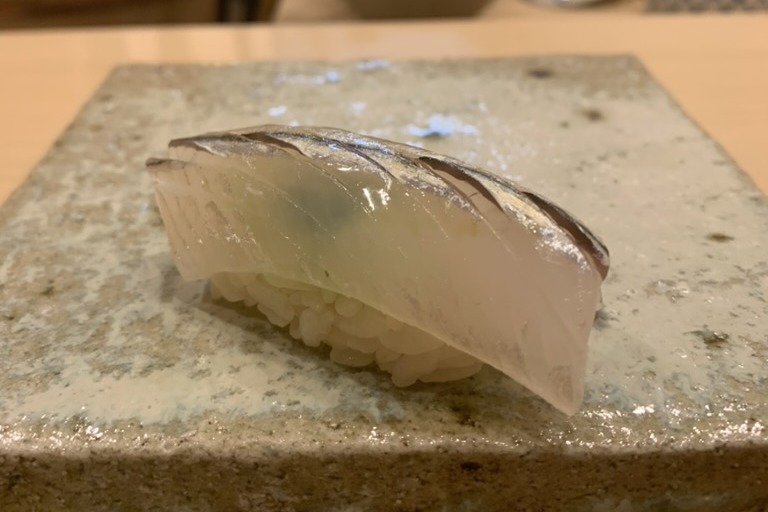
Two things are obvious from the pieces themselves. The shari is small — noticeably so, a modest mound under neta cut long enough to hang past it at both ends, which is a deliberate ratio rather than a stingy one. And the line-up is unmistakably December: buri at its fattest, snow crab in season, sayori, shima-ebi. That is not a menu assembled from a standing order. It is what a chef who was standing on the Toyosu floor that morning came home with — which is the whole argument of the shop, made on the plate.
The other half of the business
Easy to miss: Sushi Yasu runs a serious takeout trade alongside the counter, and it isn’t an afterthought. Nigiri sets run ¥4,320 for eight pieces, ¥4,860 for nine and ¥5,400 for ten, with a “Special” box of eleven from ¥11,880 to ¥16,200 at market price. There’s bara-chirashi (ばらちらし) at ¥4,320, a top-grade version at ¥6,480, and an all-tuna version at the same price. Boxes come from a packaging maker in Okegawa; for celebrations the shop will pack a wooden oke (桶) instead. Orders go through LINE, and — consistent with everything else — same-day is not possible.
This is the economics. A six-seat counter serving two groups a day cannot live on the counter alone, and the daily Toyosu run has to be paid for somehow. The takeout is what funds the market trip, and it’s the part of the business the neighbourhood actually uses — which leaves Sushi Yasu in an unusual double position: a destination counter, and in the older sense the good sushi shop in the neighbourhood.
Before you go
- Communicate with the chef before your visit, tell him about your preference. For me, it is the key reason to come. It is also easy to do Kashikiri which means “reserve for private use” for family or friends gathering.
- You take your shoes off, and bare feet are asked against — bring socks.
- Bring cash, no card.
- Closures are irregular. The shop posts open dates on a calendar on its site, but that calendar shows availability only — booking still goes through LINE or Instagram.