Sukiyabashi Jiro: the most famous name in sushi, and its family tree
In Tokyo sushi, who a chef trained under can tell you almost as much as what’s on the rice — and no name carries further than Sukiyabashi Jiro (すきやばし次郎). Ono Jiro (小野二郎), born in 1925 and a hundred years old as of 2025, spent his life at a ten-seat counter in a Ginza basement and turned it into the most famous sushi in the world: three Michelin stars, a state dinner for Barack Obama and Shinzō Abe in 2014, and David Gelb’s 2011 documentary Jiro Dreams of Sushi, which made an austere old man plating nigiri into a global icon.
What’s less often told is where that counter came from, and where it led. Jiro is not a beginning but a middle — the greatest product of one of the three houses that shaped modern Ginza sushi, and the root of a family tree that now spreads across Tokyo and beyond.
Ginza’s three great houses
Postwar Ginza sushi grew out of three celebrated houses, remembered together as the gosanke (御三家), the “three great families”: Kyubei (久兵衛), Yoshino (与志乃), and Nakada (奈加田). Each trained chefs, and each sent them out to open counters of their own through noren-wake (暖簾分け) — the blessing to carry a master’s name and recipes.
Ono Jiro came up through Yoshino, apprenticing under its master before opening Sukiyabashi Jiro in 1965. That detail is the whole point of this piece, because of the three houses it is the Yoshino line, through Jiro, that stayed at the summit.
Of the three, Nakada has all but vanished, and Yoshino is remembered today mostly as the place Jiro started. Kyubei is still very much alive — a beloved Ginza institution — but its influence on the current top tier runs less through the house itself than through its most famous offshoot, the warm, red-vinegar Kanesaka–Saito school. That leaves Jiro. Alone among the three great houses, the line that runs through Ono Jiro is still both a household name and a living, working lineage — the one of the old Ginza three that never stopped setting the standard.
The style
If the Kanesaka–Saito counters are defined by warmth and generosity, the Jiro school is defined by austerity. There are no cooked tsumami to break the rhythm, and little conversation: the meal is essentially a fast, near-silent run of around twenty pieces of nigiri, delivered one after another and eaten the moment they land — in and out in half an hour.
The signature is the rice. Where the Kanesaka–Saito counters reach for the rounder, deeper flavour of red vinegar (akazu, 赤酢), Jiro goes the other way: a shari seasoned hard with plain rice vinegar and served close to body temperature, so each piece arrives warm and bracingly, unmistakably sour — rice built to cut through the fish, not to sit quietly beneath it (on why the rice matters as much as the fish, see shari). It is a demanding style, for the chef and the guest alike — and famously expensive, north of ¥40,000 for those thirty minutes, drinks aside.
Out of the guide
For years Sukiyabashi Jiro’s Ginza honten held three Michelin stars. Then, for the 2020 guide, Michelin removed it entirely — not for any fault in the food, but because the counter no longer accepts reservations from the general public. A restaurant nobody can book, Michelin reasoned, isn’t one it can fairly list (for what a guide’s stars do and don’t tell you, see Michelin vs Tabelog).
The honten today is effectively private, run largely by Jiro’s elder son as the master nears the end of his working life — the endpoint of a slow drift toward a regulars-only door. The paradox is a neat one: the most famous sushi counter on earth is one almost no one can eat at. Which is exactly why the lineage matters.
The family tree
Jiro’s two sons keep the name directly. Yoshikazu Ono (小野禎一), the elder, runs the Ginza honten; Takashi Ono (小野隆士), the younger, opened Sukiyabashi Jiro Roppongi in Roppongi Hills in 2003, a two-Michelin-star counter of its own. Beyond the family, Jiro trained more than a hundred chefs over the decades, and the best of them now run some of Tokyo’s most sought-after rooms:
- Sushi Mizutani (すし 水谷) — Hachiro Mizutani, out of the same austere Ginza tradition, ran what many called Jiro’s equal; it reached three Michelin stars before closing in 2016, the great lost counter of the school.
- Harutaka (はるたか) — Harutaka Takahashi, after more than a decade at Jiro’s counter, opened his own Ginza room in 2006. Michelin three starred, which is also the one 3-star sushi place in Tokyo, and now a teaching kitchen in its own right.
- Sushi Masuda (鮨 ます田) — Rei Masuda, nine years under Jiro, opened in Aoyama in 2014; two Michelin stars.
- Sushi Mizukami (鮨 みずかみ) — Yukinori Mizukami, sixteen years across the Ginza and Roppongi counters, opened in Hanzōmon in 2018. Of the working Jiro-school shops it’s among the most welcoming — and one you can actually get into. I’ve written it up in the foodie log.
- Sushi Ao (鮨 あお) — Ryo Okazaki, ten years at Jiro, opened near Omotesandō in 2020.
- Nihonbashi Kawaguchi (日本橋 川口) — Yudai Kawaguchi, more than a decade under Jiro and his elder son, opened in 2025 — proof the tree is still growing.
- Sushi Nakazawa — Daisuke Nakazawa, the apprentice whose tearful egg closes Jiro Dreams of Sushi, who carried the style to New York in 2013.
Each keeps the same grammar — nigiri-forward, warm and sharply vinegared rice, restraint over spectacle — in its own hand.
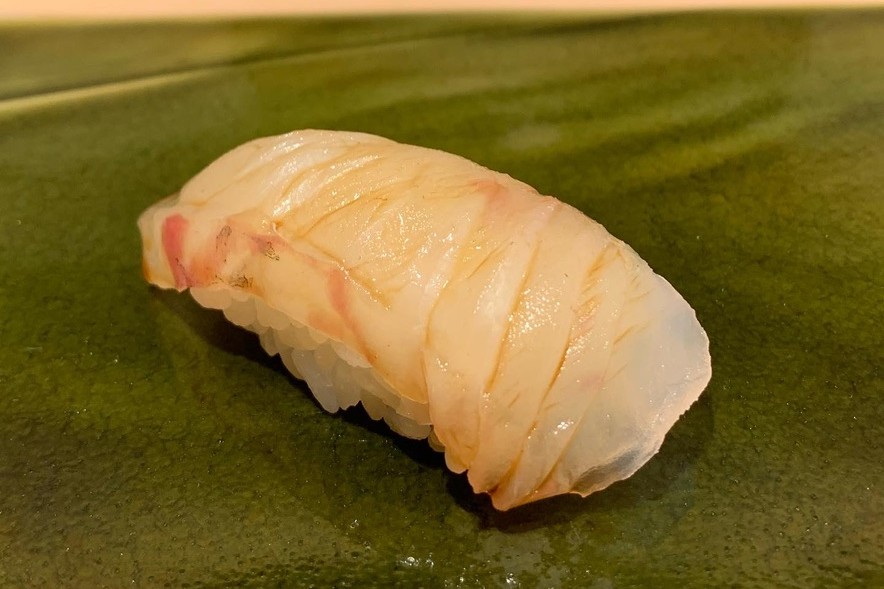
You can see that grammar at Sushi Mizukami — Yukinori Mizukami’s Hanzōmon counter, and one of the few Jiro-school rooms you can still book. The tuna alone tells the story: one fish, cut three ways, down the ladder of fat.
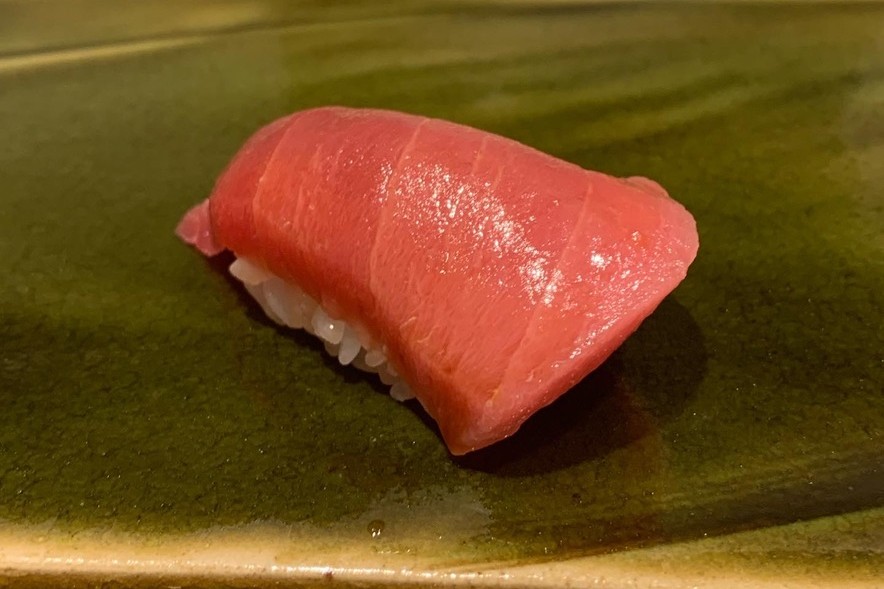
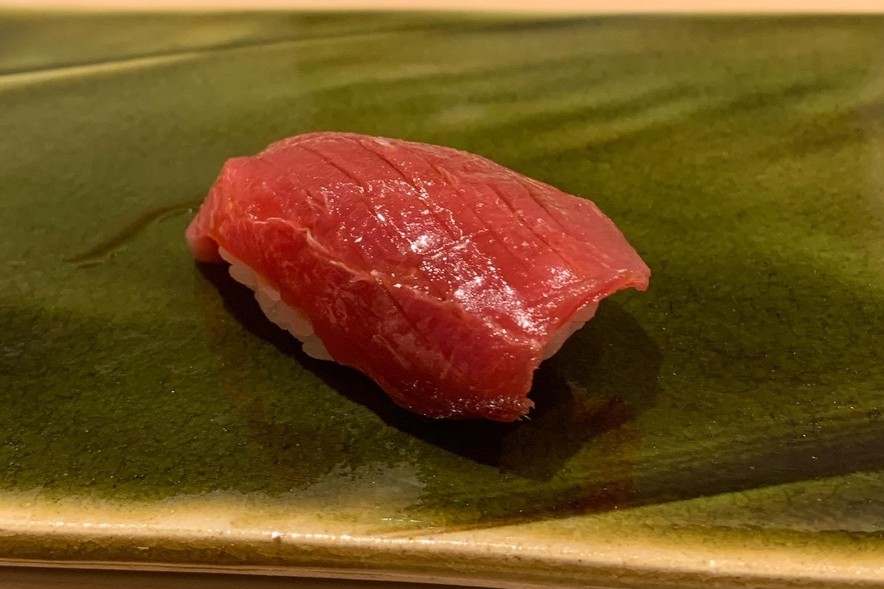
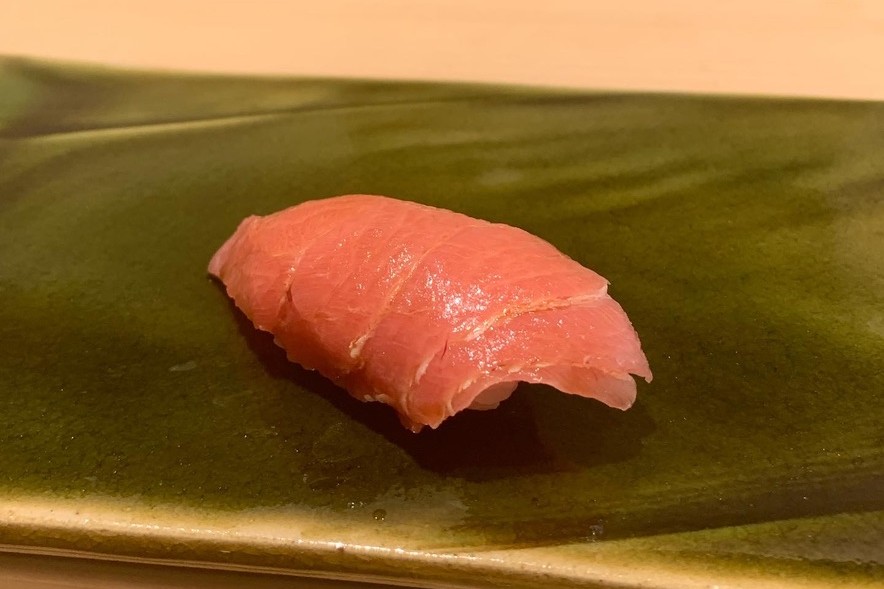
And the white fish, handled with the same restraint:
Why it’s worth knowing
The practical payoff is the same as with any Tokyo lineage. The headline counter is out of reach: Jiro’s honten doesn’t take the public, and won’t again. But the school is a map. A chef with Sukiyabashi Jiro in his history is a reliable bet for the same austere, nigiri-forward meal and the same warm, sharply sour rice — often at a seat you can still book, like Sushi Mizukami.
Read alongside its warmer rival, the Kanesaka–Saito school, the Jiro tree is half of a simple truth about Tokyo sushi: the two family trees that grew out of Ginza’s old great houses still shape most of what happens at the city’s best counters. Of the three houses themselves, only one is still a name the whole world knows — and it belongs to a man who spent seventy years making the same twenty pieces, a little better each time.