Why Nihonbashi Kakigaracho Sugita sits at the top of Tokyo sushi
Ask a Tokyo sushi obsessive to name the best counter in the city and you’ll usually start an argument. One name tends to end it: Nihonbashi Kakigaracho Sugita (日本橋蛎殻町 すぎた) — nine seats in the basement of an unremarkable building, three minutes from Suitengūmae station, run by a chef who has been quietly at the top of Japanese sushi for a decade.
What’s interesting isn’t that it ranks first. It’s that the ranking never moves — and that almost nobody who eats there talks about the ranking afterwards. They talk about how the meal felt.
What the record says
The numbers are, for once, unambiguous. Sugita has taken a Tabelog Award Gold every year from 2019 through 2026, with a score north of 4.6 — on a scale where roughly 0.05% of Japan’s restaurants clear 4.0 at all. Michelin came to the same conclusion more slowly: one star in the 2017 Tokyo guide, promoted to two in 2021, and held since.
Set that against this site’s standing position on rankings — neither Michelin nor Tabelog is a bible — and the useful question isn’t where does it rank. It’s why a crowd-sourced score that punishes any inconsistency has refused to budge for eight straight years. That’s not a hype cycle. That’s a shop doing the same thing, at the same level, every single service.
The chef, and the street he came back to
Takaaki Sugita (杉田孝明) was born in Chiba in 1973 and went straight from high school into Miyakozushi (都寿し), one of the old Edomae houses of Nihonbashi — and, as it happens, a shop on the same Kakigarachō street he works on now. He stayed twelve years.
In 2004 he went out on his own by noren-wake (暖簾分け), the blessing to carry a master’s name, and opened as Tachibanachō Miyakozushi in Higashi-Nihonbashi. Only in 2015 did he move back to Kakigarachō and put his own name over the door. He spent eleven years as an independent chef still trading under his teacher’s name before he used his own — which tells you most of what you need to know about the temperament behind the counter.
That house matters for practical reasons too, as we’ll get to: Miyakozushi is also where Sushi Hashimoto’s chef trained.
The rice
As always, start with the shari. Sugita builds his from a blend of rices led by Koshihikari, cooked in a hagama (羽釜) — the old flanged iron pot — and seasoned with a blend of Mizkan’s aged akazu (赤酢) and lees vinegar from Yokoi Jōzō. It comes out firm, distinctly saline, and deeper than it is sharp.
That places him squarely on one side of Tokyo’s great vinegar divide. Where the Sukiyabashi Jiro school seasons hard with plain rice vinegar for a bracing sourness, Sugita is in the red-vinegar camp with the Kanesaka–Saito counters — rounder, savoury, built to sit under the fish rather than cut against it. His own signature within that camp is the salt.
The other thing people describe is the shape. The pieces are packed loosely enough that a finished nigiri visibly settles when it’s set down on the counter — rice held together by almost nothing, collapsing the instant it’s in your mouth. It’s the hardest thing in sushi to do nine seats at a time, all night, without a single piece falling apart on the way over.
The meal
The course is tsumami-forward: a long, generous run of small cooked and dressed dishes before the nigiri begins at all, which is where the Nihonbashi tradition parts company with Jiro’s twenty-pieces-and-out austerity.
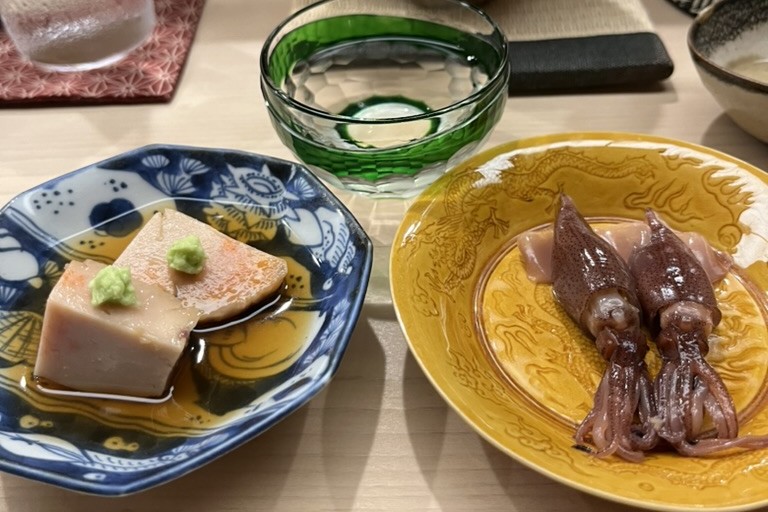
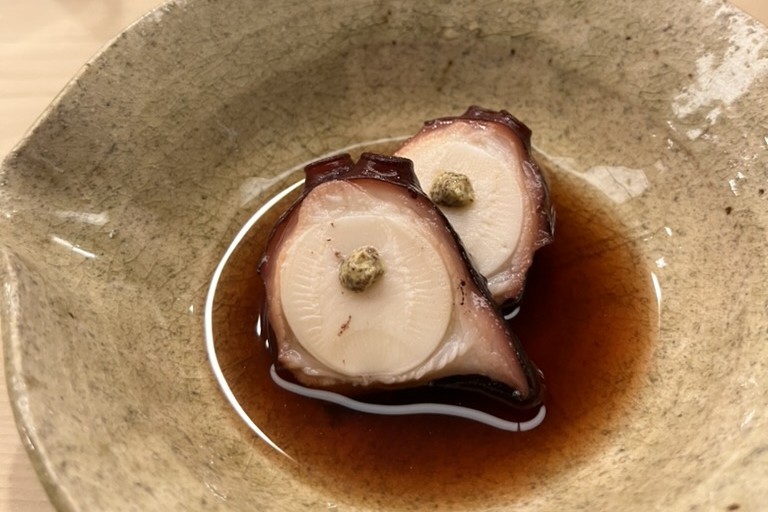
That octopus is the tell. Slow-cooked tako is one of the quiet benchmarks of an Edomae kitchen — an ingredient that turns to rubber the moment anyone hurries it, and which arrives here yielding enough to cut with chopsticks while still tasting like octopus.
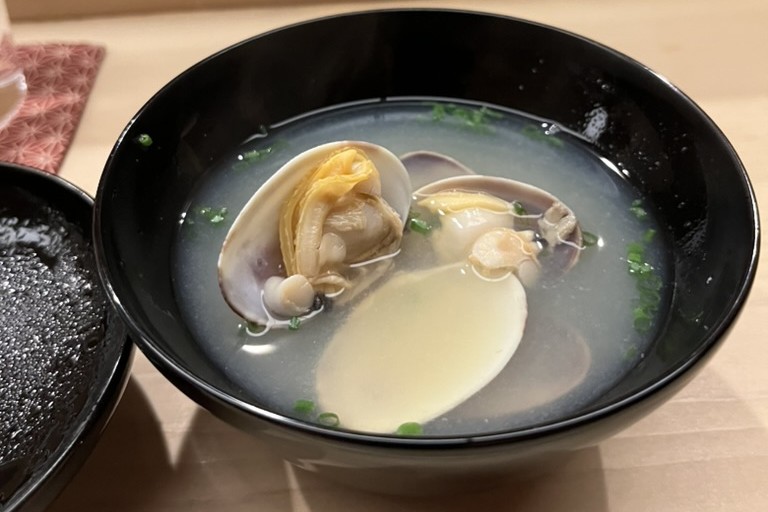
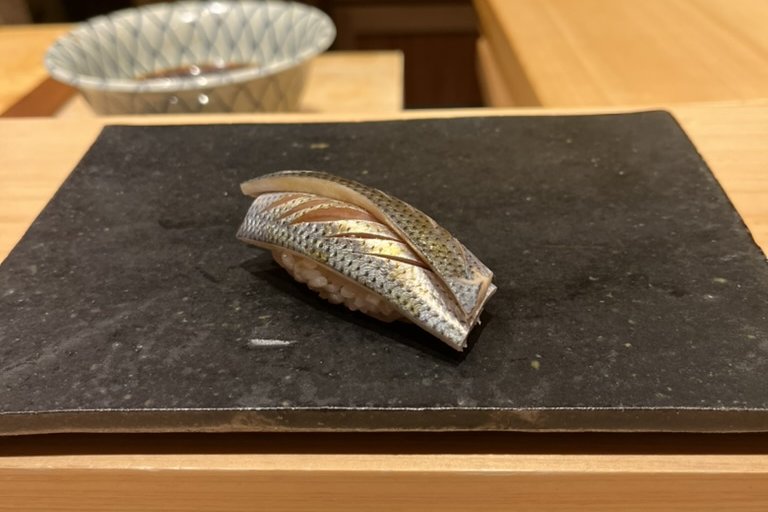
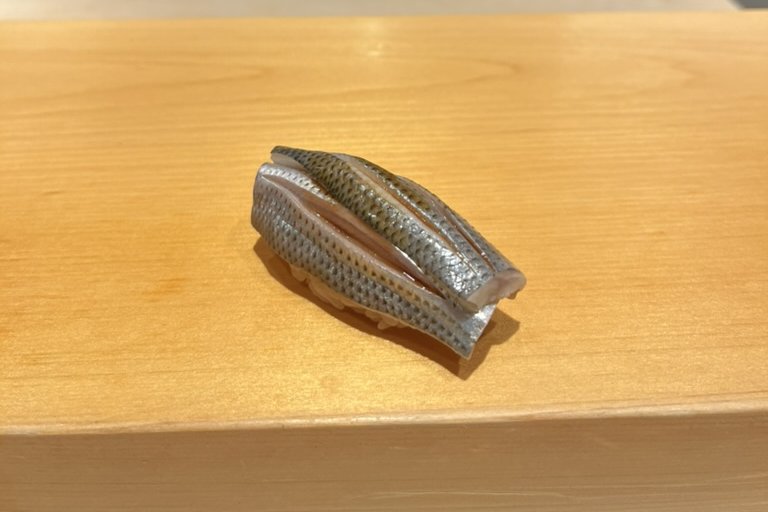
Then the nigiri. Recurring standouts are the simmered anago (穴子), the kuruma-ebi (車海老), an aji (鯵) that regulars describe as absurdly thick-bodied for the season, and above all the kohada (小肌) — the cured gizzard shad that is the benchmark of any Edomae counter, and the piece Sugita is most often judged on.
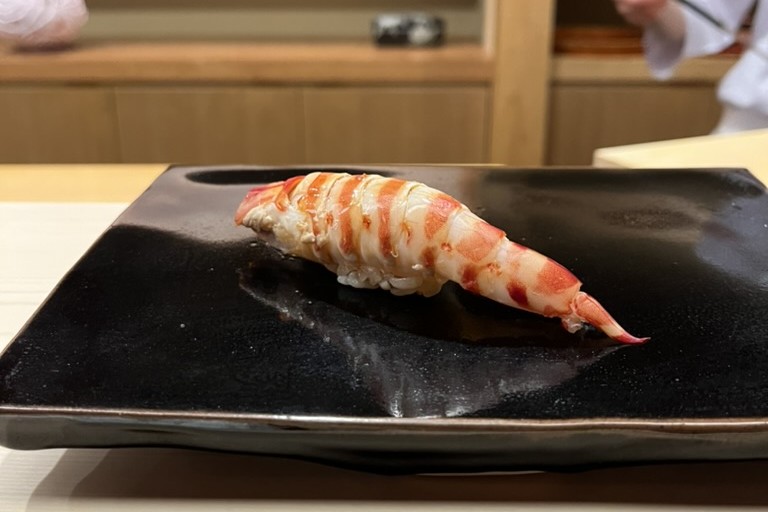
The craft note that comes up again and again is that he changes the knife work per fish — the cut adjusted to the individual specimen’s size and the firmness of its skin, rather than a house cut applied to everything. Unremarkable to look at; the whole game, in practice.
The part that actually explains it
Here’s where the ranking stops being the story.
Counters at this altitude usually solve the problem of scarcity in one of two ways. Some close the door: ichigensan okotowari, no first-timers without an introduction, the seats reserved for people the chef already knows. Others keep the door open but run the room cold — a fast, near-silent procession where you are a guest at a performance, not a person.
Sugita does neither, and that is the actual reason for the devotion. The consistent report from the counter — from Japanese regulars of fifteen years and from visitors on their first and only night alike — is that the room is warm, unhurried, and level. The chef’s attention doesn’t concentrate on the known faces at the good seats. A first-timer gets the same reading of their pace, the same adjustments, the same welcome. He is by every account a genuinely gentle presence in a profession that has never required its stars to be.
One honest caveat: there is no English at the counter. The hospitality is carried by manner, timing and attention rather than by conversation, and it survives the language gap intact — but don’t arrive expecting to be talked through the meal.
That combination is rarer than the food. Plenty of chefs can cure a kohada. Very few rooms at the top of the market have declined to become either a private club or a theatre.
What it costs
The omakase runs ¥49,500 including tax, with a 10% service charge on top — and it moves with the market, so treat that as this season’s figure rather than a fixed price. As ever on this site, drinks are extra and are never part of the meal price; with sake, an evening here lands comfortably past ¥60,000.
Worth saying plainly: Sugita used to be one of the great value plays in Tokyo, a shop delivering the city’s best sushi for well under what Ginza charged. That gap has closed. It is now priced like what it is.
The door
Access is the real cost. The current shape of it:
- First-timers book through OMAKASE (omakase.in), the English-capable platform — the same one that handles Hashimoto and Yamato. Phone booking is no longer the route in.
- Regulars are handled separately, with dates released to them directly. This is the ordinary economics of a nine-seat room, not a snub — see why the best counters run on regulars.
- Cancellations surface a day or two out, which is genuinely how a lot of visitors get in. Watch, don’t hope.
- Lunch is the softer target, as it is almost everywhere — the general principle in how to get a reservation in Japan.
If you can’t get in — and you probably can’t
The good news is that this particular summit has two well-marked paths down, and both are bookable.
Sushi Hashimoto (鮨 はしもと) in Shintomi comes from the same house: Hiroyuki Hashimoto spent nine years at Miyakozushi, rising to second chef, before opening his own Michelin-starred eight-seater in 2014. It is the same classical, rice-forward Nihonbashi Edomae grammar, in a notably generous hand — his nigiri are cut around 1.5× the size of the Tokyo norm. Around ¥40,000, bookable on Omakase.in, and a short walk from Ginza.
Sushidokoro Yamato (鮨処 やまと) in Tsukiji is the direct descendant: Yamato Yasui trained under Sugita himself, after starting in kaiseki at the two-star Ginza Kojyu. The Sugita influence is unmistakable — exacting, rice-first, plain in the confident way — and his kohada has become the shop’s calling card. Dinner is about ¥33,000 and lunch ¥19,800, which is one of the gentlest ways into sushi of this pedigree anywhere in Tokyo. Having eaten at both, my honest read is that Yamato delivers something like 80% of Sugita at well under half the price and a fraction of the difficulty — which, given what the other 20% costs in money and waiting, is a very good trade.
Why it stays there
Sugita’s position at the top isn’t a mystery of technique. There are perhaps a dozen chefs in Tokyo who can match the knife work, and a handful who could argue about the rice.
What almost nobody matches is the combination: sushi that good, served in a room where nobody is being ranked. The scarcity is real and the price has caught up with the reputation, but the thing the counter is actually famous for is free — a chef who is as glad to see a stranger as a regular, doing the same nine seats, twice a night, with no apparent interest in being anywhere else.
That’s the part the score can’t measure, and the part his students carried out with them.