Maguro: all you need to know about tuna
Maguro (鮪) is the king of the counter — the fish that anchors almost every omakase, and the one most people reach for first. But “tuna” hides a great deal. Under the word sit several different species, a fattiness gradient that runs from lean and iron-red to white-marbled and melting, a history that completely flipped the fish’s status, and a global supply chain stretching from the Tsugaru Strait to the Mediterranean. Once you can see all of that in a single piece of nigiri, maguro becomes the most interesting fish on the board.
The species that matter
Not all tuna is the same fish.
Honmaguro / kuromaguro (本鮪 / 黒鮪) — Pacific bluefin, the apex. Hon means “true,” and this is the tuna the great counters chase: large, deeply seasonal, and the source of the toro you dream about. It fattens as the water cools.
Minami-maguro (南鮪) — southern bluefin. Deep-colored and rich, it’s the off-season stand-in when bluefin isn’t at its best.
Mebachi (目鉢) — bigeye. The everyday workhorse of mid-range counters: solid akami, less fat, available year-round.
Kihada (黄肌) — yellowfin. Leaner and paler, common in summer and in cheaper sushi; it’s the “tuna” most of the world knows from cans and seared steaks.
Binnaga (鬢長) — albacore, sometimes sold as bincho. Pale, soft, and mild — a budget neta.
Bluefin is the one worth crossing a city for. The rest mostly fill the gaps.
The cuts: a map of the fish
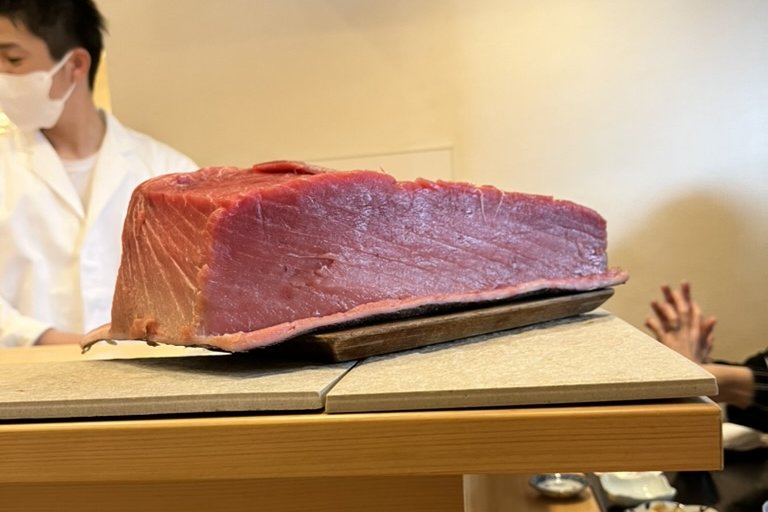
A single tuna yields several different neta, graded almost entirely by fat:
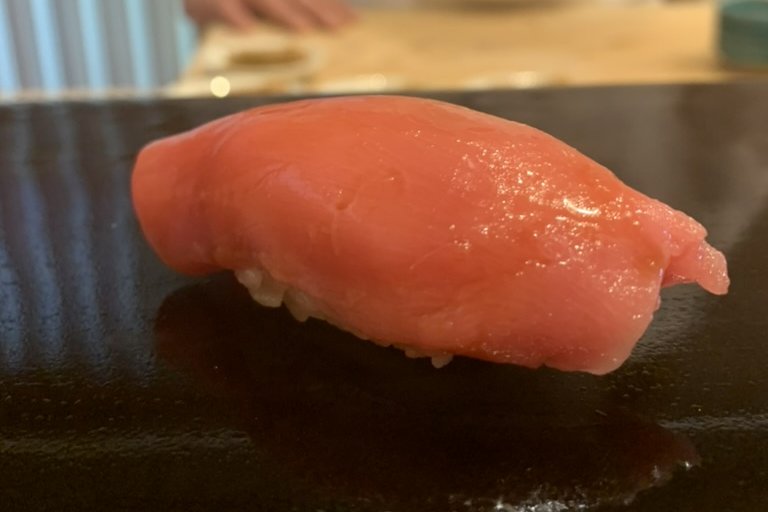
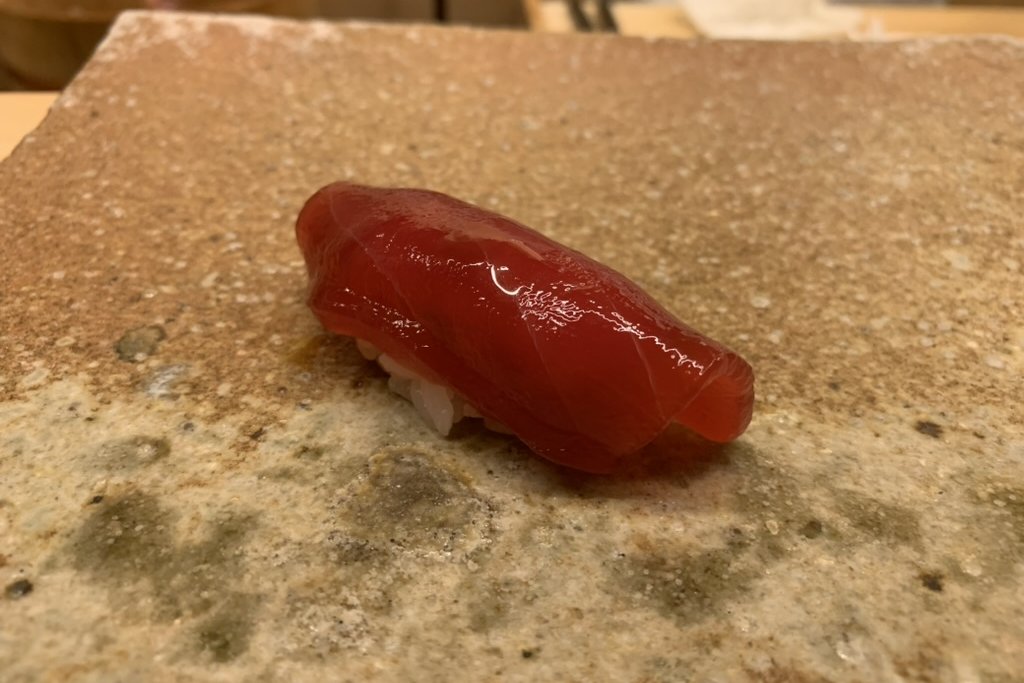
- Akami (赤身) — the lean red meat from the upper loin and back. Deep, faintly iron-tinged, this is the soul of maguro and the cut chefs quietly respect most. Often served as zuke (see below).
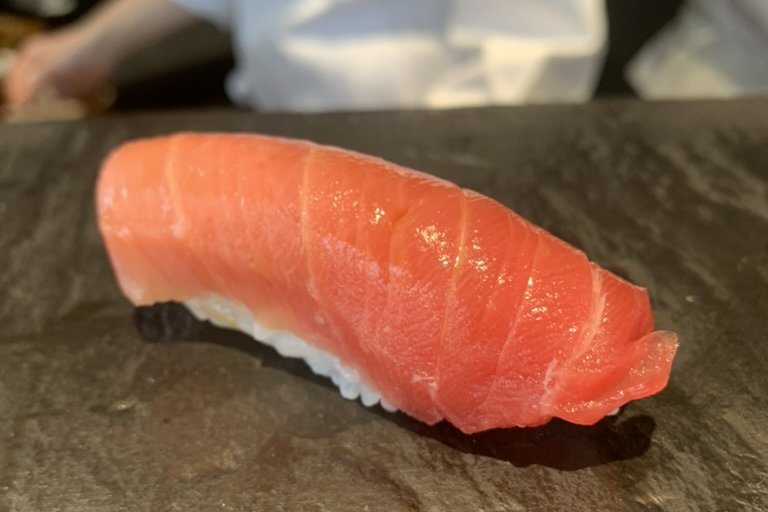
- Chūtoro (中トロ) — medium-fatty, from the belly and the zone between akami and ōtoro. The balance point: enough fat to feel luxurious, enough lean to still taste of fish.
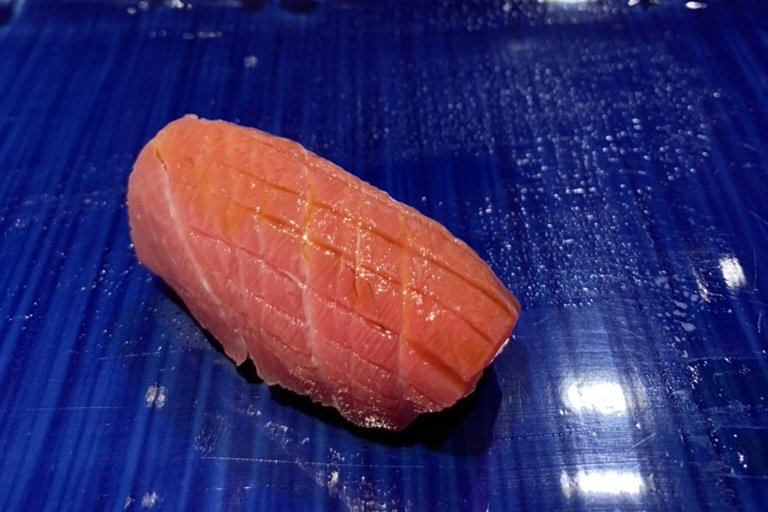
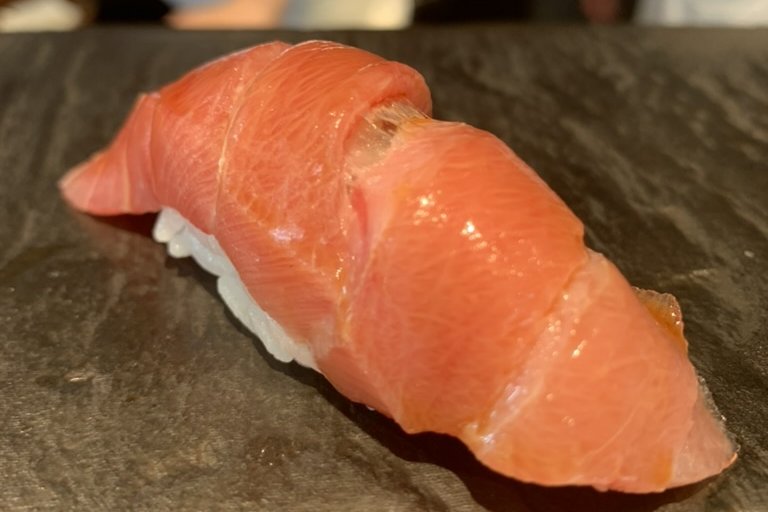
- Ōtoro (大トロ) — the fattiest belly, shot through with white marbling (shimofuri, “fallen frost”). It melts on contact and is the priciest piece on most menus. Its richest section, near the front of the belly, carries the striped jabara (蛇腹, “accordion”) pattern of alternating fat and fine sinew — the most marbled cut of the whole fish.
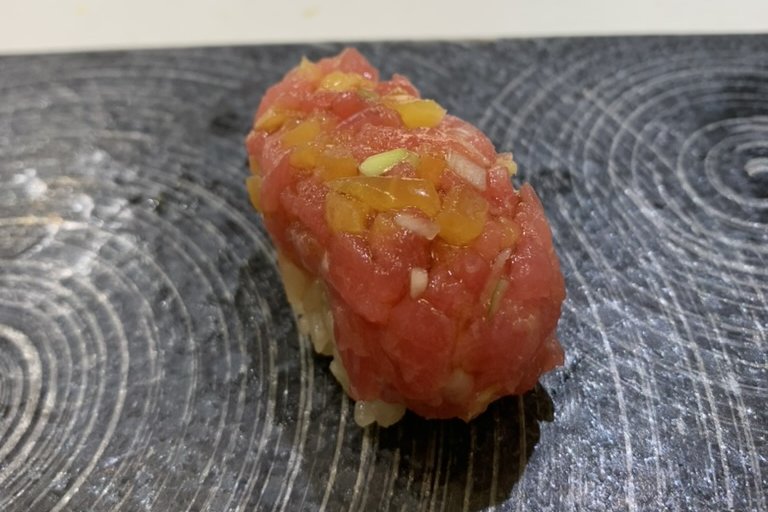
Beyond the big three, chefs prize a run of odd cuts, most yielding only a handful of pieces per fish: kamatoro (カマトロ), the rare, ultra-fatty collar; hohoniku (頬肉), the firm, meaty cheek; noten (脳天, also called tenmi), the rich crown of meat from the top of the head; sunazuri, the fattiest belly streak; the belly sections harakami and haranaka; and nakaochi (中落ち), the meat scraped from along the bones. Those scrapings, minced and mixed with chopped scallion, make negitoro — far more common than any of the rest, served as a roll or piled over rice. One fish, a dozen experiences.
The fish that was once thrown away
It’s hard to believe now, but toro used to be the cheap part. Before refrigeration, the fatty belly spoiled fast and was disdained — sometimes fed to cats, sometimes discarded outright — while lean akami, which kept far better, was the prized cut. The Edomae solution was zuke (漬け): steeping akami in soy (and often nikiri) both to preserve it and to deepen its flavor.
Only in the twentieth century — with refrigeration, a postwar appetite for fat, and changing tastes — did toro climb to the top of the menu. The hierarchy you see today, with ōtoro as the luxury, is barely a hundred years old.
Season and origin
Bluefin is at its best in winter. As the sea cools, the tuna lays on fat, and toro peaks from late autumn through the cold months. The most storied catch is Oma (大間) bluefin, line-caught off the tip of Aomori in the Tsugaru Strait — “black diamonds,” routinely the single most expensive fish in Japan.
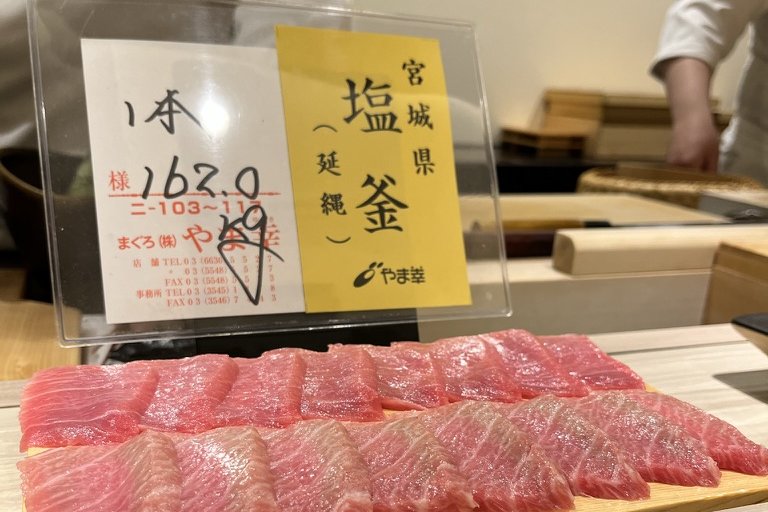
Other domestic ports (Katsuura, Shiogama, Toi) and a large imported supply — Boston, Spain, Malta, Croatia — keep counters stocked the rest of the year. Increasingly you’ll also meet yōshoku (養殖), farmed bluefin, now good enough to appear at serious counters and not just budget ones.
Aging
Top-tier sushi is as much about aging (熟成, jukusei) as it is about freshness. Tuna is bought in large blocks and rested — days for akami, sometimes weeks for a loin — under careful temperature and humidity, so enzymes break proteins down into amino acids and the flavor turns deeper and almost meaty. Specialist wholesalers built their names on aged maguro (Yamayuki is the most famous), and a chef’s choice of supplier and aging is a big part of why two counters’ tuna can taste worlds apart.
The auction
Tuna is theatre before it’s food. At Toyosu — Tokyo’s wholesale market, successor to Tsukiji — whole bluefin are laid out at dawn and sold by hand-signal auction. The New Year’s first auction (hatsuseri) is a national event: in January 2019, Kiyoshi Kimura of the Sushi-Zanmai chain paid ¥333.6 million — about $3 million — for a single 278-kilogram Oma bluefin, a record set as much for publicity as for the fish. Ordinary mornings are calmer, but the same tuna flows from that floor to the city’s counters within hours.
At the counter
In an omakase, tuna usually arrives as a run, built light to fat: akami (often zuke) first, then chūtoro, then ōtoro, so richness climbs without flattening what came before. (More on that sequence in the anatomy of a sushi omakase.) Good akami is served cool and clean; toro is best a touch closer to room temperature, so the fat softens and releases on the tongue. And don’t overlook the akami — many chefs rate it above toro precisely because lean meat has nowhere to hide.
Where to eat it well for less
The fine-counter version of tuna is only half the story — and not the only way to eat it well. A few specialists serve top-grade maguro at a fraction of omakase prices.
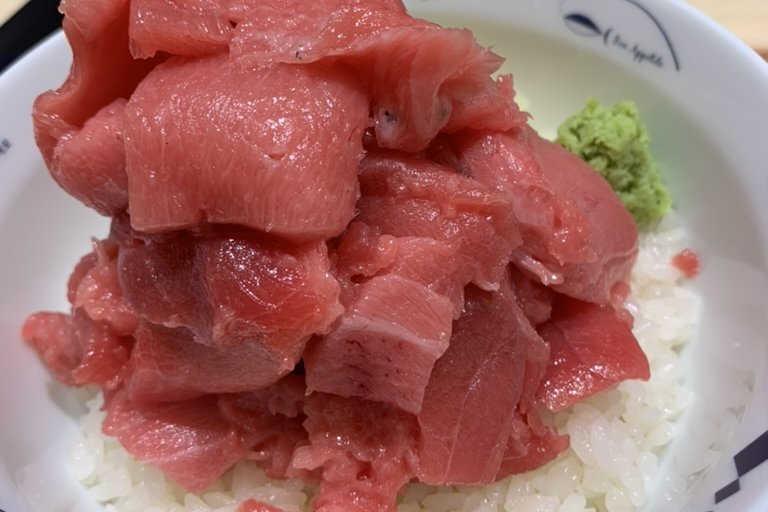
The clearest example is Seagen (海玄), tucked into the Tsukiji outer market and run by Yamayuki — the same wholesaler whose name turns up on the city’s best counters. It serves only wild Oma bluefin, heaped over rice with akami, chūtoro, and ōtoro side by side, for around ¥1,000–3,000 — a bowl that would cost many times that at a sushi-ya. (Closed Wednesdays and Thursdays; expect a queue before it opens.)
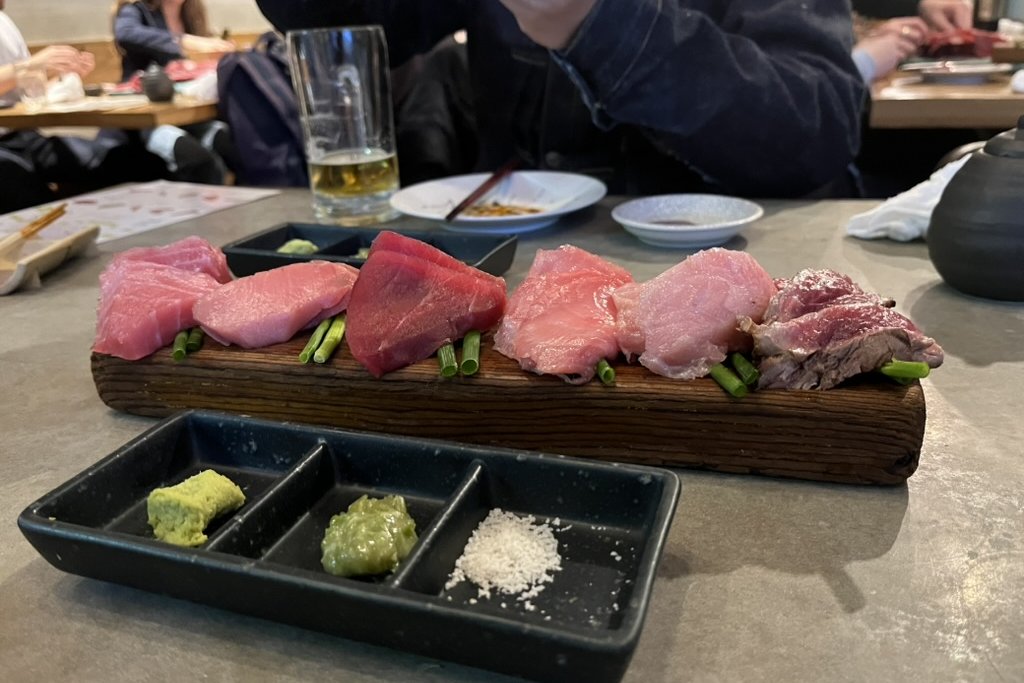
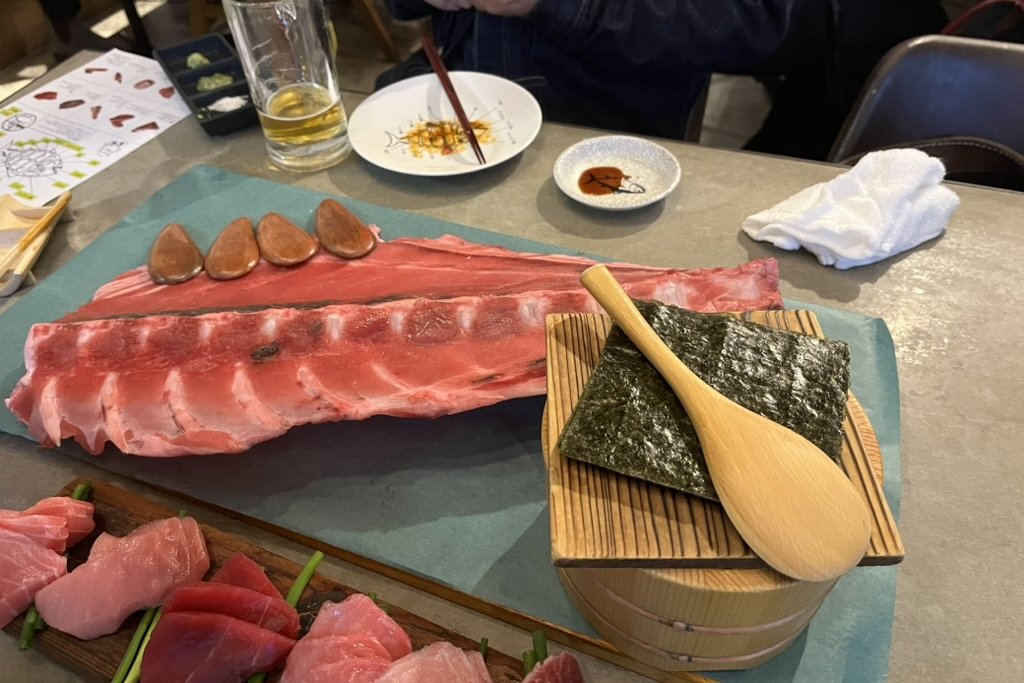
For the full nose-to-tail version, Maguro Mart (マグロマート), a tuna izakaya about ten minutes from Nakano station, makes the whole fish the menu: a single board runs the entire gradient, lean akami through chūtoro and ōtoro to the odd cuts, with wasabi and salt to compare. It will even hand you the belly bones with nori, rice, and a paddle, and let you scrape the nakaochi and roll it yourself. (Reservations essential — book up to a month ahead.)
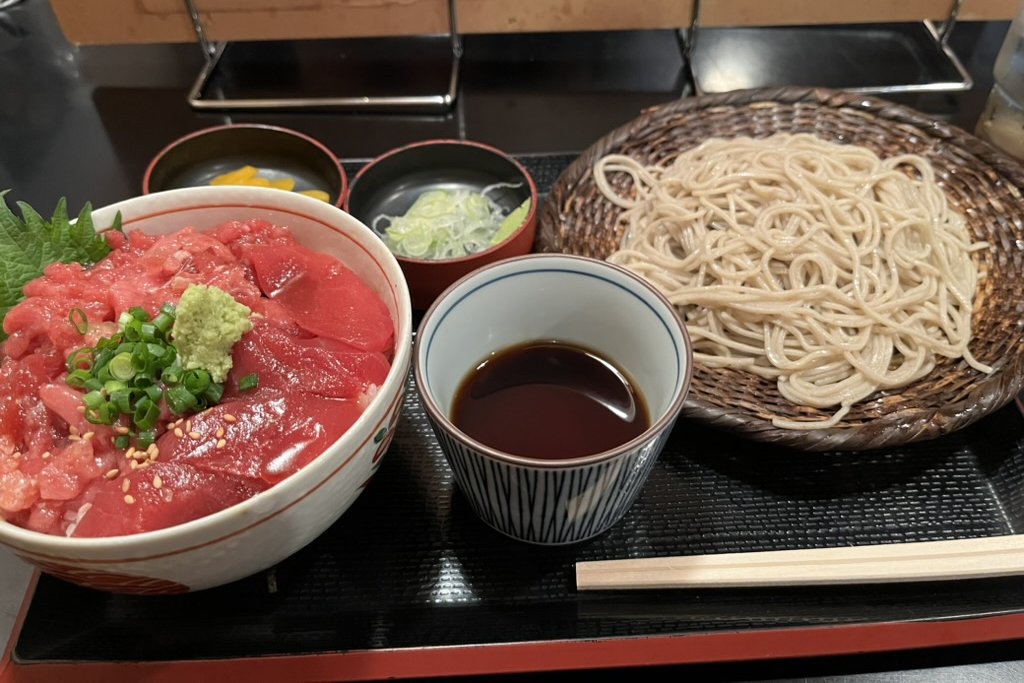
And it isn’t only the specialists. In countless traditional soba shops, a medium maguro don comes paired with a basket of cold soba — a humble, satisfying everyday combination you’ll find all over Japan.
A note on sustainability
Tuna’s status comes at a cost. Pacific and Atlantic bluefin were both heavily overfished, and bluefin is now managed under international quotas (ICCAT and others). Stocks have recovered unevenly — Atlantic bluefin strongly, Pacific bluefin more slowly but improving under tighter limits. Full-cycle farming, pioneered by Kindai University when it first closed the bluefin lifecycle in captivity, is easing pressure on the wild population and has become a mainstream source. Eating maguro thoughtfully means remembering that the most prized fish at the counter is also the one most worth ordering with care.
From a cut once given to cats to the most expensive fish in the sea, maguro carries more history per bite than anything else on the counter — and it rewards knowing exactly what you’re looking at.